

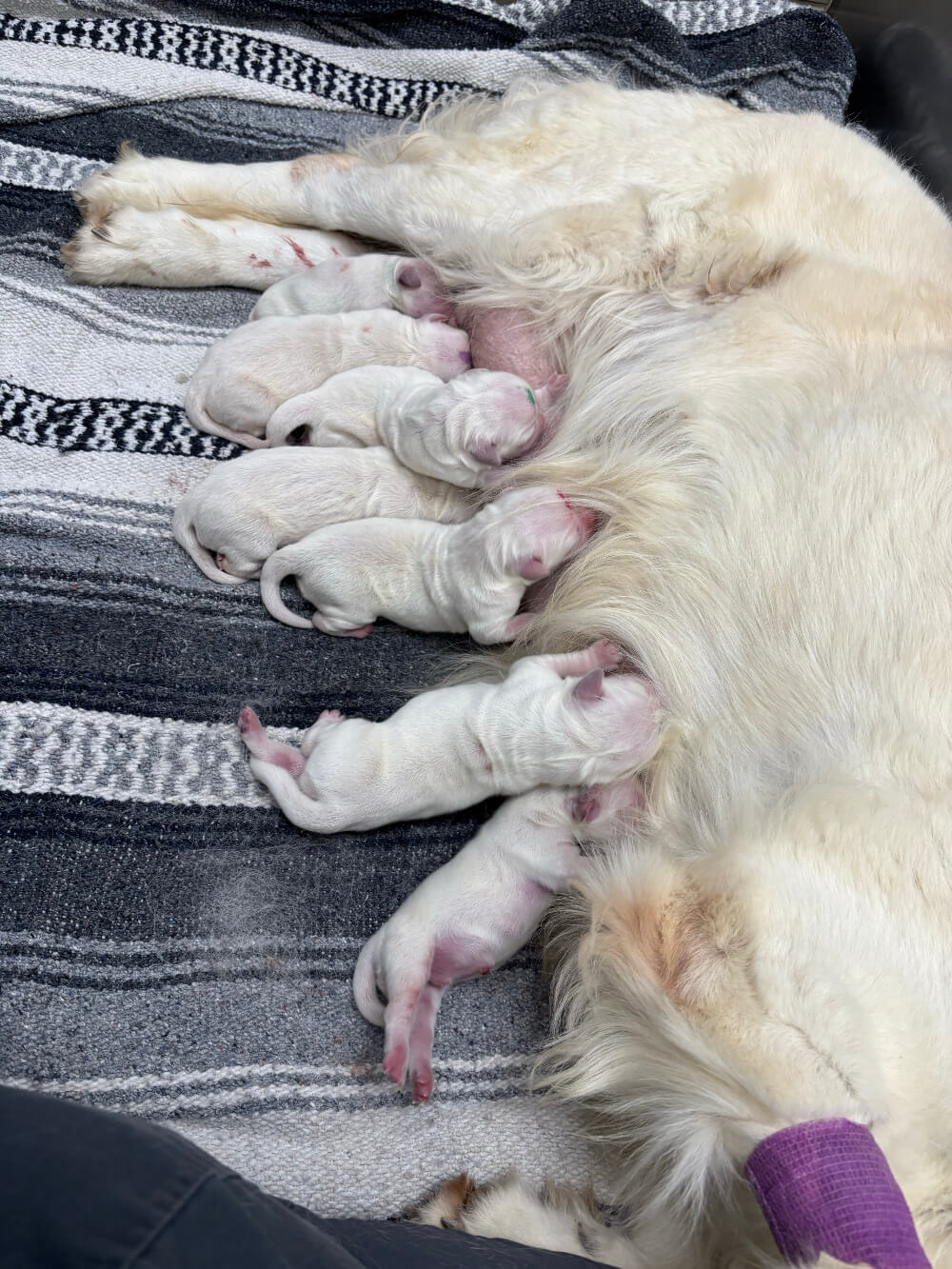
 Dr. Clark and the Staff at Angleton Veterinary Clinic are pleased to offer extended Reproductive Services.
Whether you're planning your first litter or you've been breeding for years, Dr. Clark can offer the insight and services you need to breed successfully.
For professional breeders, every litter is critical. Producing healthy puppies without jeopardizing the mother’s health is a challenging task, and it is a job that you should not take lightly. When you have questions about something as serious as canine reproduction, your veterinarian is always your best source of information.
If you’re online trying to learn more about dog reproduction services, we’re glad you found us. We’ve answered some of the questions we hear most often from breeders below. If there’s something we haven’t covered, our team in Angleton, TX, is here to help.
For new clients, we offer breeding consultations. This allows us to tailor our services to your breeding objectives. We offer counseling and testing for genetic disorders as well as education on the basics of canine reproduction.
Angleton Veterinary Clinic performs testing and procedures to support our breeders, including, but not limited to:
- Progesterone testing for ovulation timing, pregnancy maintenance and C-section timing.
- Artificial insemination using fresh semen, fresh-chilled semen shipped to the owner or clinic, and frozen semen.
- Surgical artificial insemination.
- Semen evaluation for both quality and quantity of sperm (per cc of semen).
- Ultrasound for pregnancy confirmation as well as reproductive disorders.
- X-rays to estimate puppy numbers in late pregnancy.
- Cesarean section (C-section or surgical delivery of puppies).
- Semen collection and shipping.
- Brucellosis testing.
- Diagnostics for animals with a history of breeding problems.
We can continue to provide your pet with care before and after breeding to ensure wellness and safety.
What do I need to know if I want to breed my dog?
If you want to breed your dog, you need to make sure they are healthy. To do this, you’ll need to schedule a health screening. As your dog’s veterinarian, we can help you determine whether they are the right age and in suitable health for breeding.
What is the most important factor when considering canine reproduction?
Responsible breeders only breed males and females who add value to the gene pool. It is highly irresponsible to breed your dog just because you think they would produce cute puppies or as a source of quick income.
Before breeding, you should evaluate your dog on several factors, including:
- Temperament
- Overall health
- Nutritional status
- Personality
Will my dog need breed screening, and do you provide it?
Most dogs should undergo some type of health screening before breeding. The Orthopedic Foundation for Animals (OFA) promotes the health and welfare of companion animals by reducing genetic disease. The OFA’s Canine Information Health Center (CIHC) lists health screenings that are recommended for dogs based on their breed. This is a valuable resource for anyone thinking about breeding their dog.
The CIHC bases its health screening recommendations on guidelines from breed clubs. There are recommendations for pure breeds and several common mixed breeds, including Labradoodles and Goldendoodles.
Eye exams and x-rays have to be performed by a veterinarian, and we offer both here. There are, however, some DNA tests you can perform at home using cheek swabs that you submit directly to the testing laboratory.
Do you provide dog infertility consultations?
Yes. Reproductive medicine is a specialized field — in the United States, only around 100 veterinarians are actively involved in theriogenology, or canine reproductive services. If you plan on breeding dogs professionally, you need a veterinarian who genuinely enjoys working with breeders. Dr. Clark does, and we offer infertility consultations along with diagnostics for animals with a history of breeding problems.
How do you assess fertility in dogs?
Assessing fertility is easiest in male dogs. To do so, we perform a semen collection and assessment. We look at the swimming action, shape, and count of the sperm. We also assess how long the semen lives once placed in an extender (liquid preservative).
Fertility is much harder to assess in females. In most cases, we don’t know if females have good fertility or not until after breeding. Age and poor nutrition are two of the most common causes of infertility in females, so we look at these things closely. Young dogs who receive appropriate nutrition are much less likely to have fertility issues.
What is the reproductive age range for a dog?
We generally recommend waiting until your dog is at least two years old before breeding them. This gives them plenty of time to finish growing and provides ample opportunity to complete reproductive testing. While some breeders start breeding their dogs earlier, we never recommend doing so during the first heat cycle.
Once a dog reaches six years of age, their fertility decreases by about 33 percent. While you can safely breed male dogs as long as they can still produce sperm, we don’t recommend breeding females after the age of eight.
How will I know if my dog needs help breeding?
If you know that the timing is right for breeding your dog, but you have not achieved a successful mating, this indicates that your dog may need help breeding. When you bring your dog in for a visit, we’ll likely recommend progesterone testing to determine if the timing is right and if you should proceed with the process. From there, we can collect a semen sample and perform a vaginal, transcervical, or surgical insemination.
What is the procedure for surgical insemination?
We make an incision similar to that made during a spay while the dog is under general anesthesia for surgical insemination. Once we exteriorize the uterus far enough to see where we want to place the semen, we place a catheter or needle in the uterus and inject the semen. Then, we close her up and suture the incision. Once she wakes up, she’ll be ready to head home.
Transcervical insemination is a common alternative to surgical insemination. The dog is awake during this procedure because there is no incision. Instead, we use a rigid endoscope to deliver semen directly into the uterine horns in a much simpler manner than surgical insemination.
Can I inseminate my dog at home?
If you choose to do vaginal insemination, you can inseminate your dog at home without veterinary assistance. The AKC allows clients to do their own vaginal inseminations and register the litter as an assisted semen breeding. However, keep in mind that this method is only appropriate with fresh semen. Frozen semen should only be used in transcervical or surgical insemination, both of which we perform here, because the success rate of vaginal insemination using frozen semen is only around 11 percent.
Do you offer progesterone testing for dogs?
Yes. Progesterone testing is central to reproductive work, and we use it to time ovulation, maintain pregnancies, and schedule C-sections. Interpreting the results takes experience, and it is an area where many practices refer their clients elsewhere. Dr. Clark reviews your dog’s results and will walk you through what they mean for your breeding timeline.
How is my dog’s pregnancy status evaluated?
Performing an abdominal ultrasound is the best way to evaluate your dogs’ pregnancy status. We can usually do this between days 24 and 28, depending on how you timed the bitch. We also perform a blood test known as a relaxin test. However, the downside to this test is that while it lets us know if the female formed a placenta, it doesn’t tell us if there are living puppies or how many there are. The relaxin test also doesn’t account for resorption, which is problematic since roughly 30% of conceived puppies are resorbed.
What is whelping assistance for dogs?
As veterinarians, we offer a few different types of intervention for whelping. Many breeders whelp their dogs at home without veterinary assistance, and we are here for the deliveries that need help.
Common whelping assistance services for dogs include:
- Scheduled C-sections
- Emergency C-sections
- Monitoring a dog’s uterine contractions
With the help of a telemedicine service known as WhelpWise, you can monitor your dog’s uterine contractions during the whelping process using a purchased or rented monitor. These monitors assess the quality, length, and timing of uterine contractions and can help you determine if your dog needs medical whelping assistance, such as oxytocin or calcium injections.
Can dogs have Cesarean sections?
Yes, dogs can (and often do) have Cesarean sections. Some breeds are prone to dystocia, or difficult whelping that can progress to a life threatening emergency. Dogs who have had difficulties during previous births may also require C-sections.
Breeds that commonly require Cesarean sections include:
- Pugs
- Bulldogs
- French Bulldogs
- Shih Tzus
- Pembroke Corgis
- Cardigan Welsh Corgis
- Greater Swiss Mountain Dogs
- Bernese Mountain Dogs
If your dog likely needs a C-section, we recommend scheduling one in advance. Based on the progesterone test results, we can determine when your dog ovulated and schedule a C-section based on this information. In doing so, we can ensure a safe delivery while eliminating the risk of having your dog go into labor and needing an emergency C-section.
Are there any risks associated with breeding my dog?
Before breeding your female dog, it’s crucial to understand the risks associated with breeding and think hard about the potential consequences. While complications are infrequent and often not life-threatening, there is always a chance that your dog could experience difficulties during pregnancy, labor, natural birth, or a C-section. Dogs can also develop metritis or mastitis after delivery. Again, the risk is small, but it’s never non-existent.
Is there a sperm bank for dogs?
Yes, there are several sperm banks for dogs. Some clinics have independent sperm banks for dogs, and some companies have franchises. There are canine sperm banks across the country and around the world. We handle semen collection and shipping ourselves, and we perform artificial insemination using fresh, fresh-chilled, and frozen semen, so we can manage that side of a breeding for you.
We strive to offer you and your pet a high quality of care and service here at Angleton Veterinary Clinic. Call to make an appointment to consult with Dr. Clark about your pet reproduction needs. We are here to serve you.
At Angleton Veterinary Clinic, your pet is our priority. If you have any questions, don't hesitate to call our team at (979) 849-8524, or you can email us at [email protected]. Our staff would love to talk with you! Don't forget to follow us on social media: Facebook, Instagram.